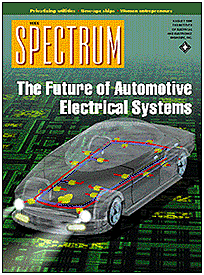
 Read more about MAEStrO in the August 1996 issue of the IEEE Spectrum.
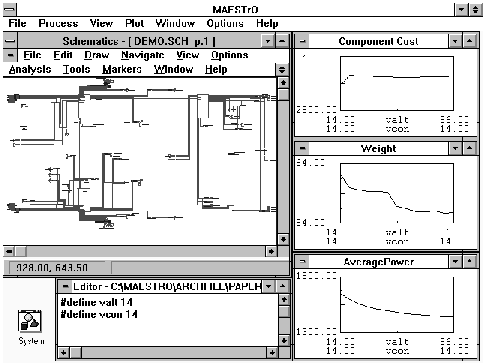 The Multi-attribute Automotive Electrical System
Trade-Off tool (MAESTrO) was initially developed to facilitate the
design and evaluation of alternative electrical power system
architectures for electric vehicles. Since then MAESTrO has evolved
into a user-friendly design and analysis environment that can be used
to evaluate electrical power systems of internal combustion engine,
electric or hybrid vehicles. The present version of MAESTrO is written
in C++ using an object-oriented paradigm and has a Microsoft Windows
based graphical user interface. The interface allows the user to
analyze the architectures and evaluate the results. In addition, the
user interface integrates Schematics and S-PLUS into the MAESTrO
environment. These third party software packages provide schematic
capture and multi-attribute trade-off analysis facilities,
respectively.
The Multi-attribute Automotive Electrical System
Trade-Off tool (MAESTrO) was initially developed to facilitate the
design and evaluation of alternative electrical power system
architectures for electric vehicles. Since then MAESTrO has evolved
into a user-friendly design and analysis environment that can be used
to evaluate electrical power systems of internal combustion engine,
electric or hybrid vehicles. The present version of MAESTrO is written
in C++ using an object-oriented paradigm and has a Microsoft Windows
based graphical user interface. The interface allows the user to
analyze the architectures and evaluate the results. In addition, the
user interface integrates Schematics and S-PLUS into the MAESTrO
environment. These third party software packages provide schematic
capture and multi-attribute trade-off analysis facilities,
respectively. For a given architecture, MAESTrO calculates the system, subsystem and component attributes. Among the attributes calculated are component cost, installation cost, weight, average losses, average power consumption, general failure rate and mission failure rate. General failure rate measures the failure rate of most of the system, while mission failure rate measures the failure rate of only the mission-critical parts. A mission-critical part is one whose failure could prevent the vehicle from reaching its destination.
Architectures are designed in Schematics using a custom automotive parts library. The components available from the library include motors, solenoids, lamps, heaters, electronic and generic loads, connectors, wires, switches, fuses, power converters, batteries and generators. Once an architecture has been drawn, component parameters such as alternator voltage, wire lengths and switch types are specified. Some of these parameters can be defined as variables, in which case MAESTrO will determine the variation in the architecture's attributes as a function of the variables.
To minimize the effort on the part of the user, the distribution components, batteries and generator are sized automatically by MAESTrO. The user only has to specify power consumption, state under various driving scenarios and criticality at each load; nominal voltages, frequencies and positive and negative fractional deviations in voltages at the output of the generator and converters; and fractional voltage deviations at the batteries. MAESTrO uses a breadth-first search algorithm to propagate the voltage, frequency, voltage deviation, power and criticality information across the network. Once all the components have been sized, MAESTrO calculates the attributes of the distribution components, batteries and generator using built-in component attribute models.
Read more about MAEStrO in the August 1996 issue of the IEEE Spectrum.
Khurram K. Afridi
MIT, Room 10-082
77 Mass. Ave.
Cambridge, MA 02139, USA
Tel: (617) 258-8494
Fax: (617) 258-6774