<?xml version="1.0" ?><entry xml:lang="en" xmlns="http://www.w3.org/2005/Atom" xmlns:planet="http://planet.intertwingly.net/"><id>http://price.mit.edu/blog/?p=3</id><link href="http://price.mit.edu/blog/2010/02/unlocking-the-clubhouse/" rel="alternate" type="text/html"/><title>Unlocking the Clubhouse, part 1: it’s not about innate differences</title><summary>If you work on computing in school, on the side, or in industry and you’ve been paying attention to the people around you, you’ve probably wondered why so many fewer women than men enter our field and stay in it.
This is no immutable law.  In fact, the proportion of women in computer science in [...]</summary><content type="xhtml"><div xmlns="http://www.w3.org/1999/xhtml"><p>If you work on computing in school, on the side, or in industry and you’ve been paying attention to the people around you, you’ve probably wondered why so many fewer women than men enter our field and stay in it.</p>
<p>This is no immutable law.  In fact, the proportion of women in computer science in the United States was once much higher.  Of people receiving bachelor’s degrees in computer science, women made up <strong>nearly 40% in the mid-1980s, declining to 20% in 2006</strong>.  (<a href="http://www.cs.washington.edu/homes/letchner/classwork/cs201/main.html">graphs</a>, <a href="http://www.nsf.gov/statistics/nsf08321/pdf/tab34.pdf">NSF data</a>.)  And it varies among cultures, too—in Malaysia, <strong>women actually outnumber men</strong> in computer science.  (<a href="http://www.cs.cmu.edu/~cfrieze/courses/malaysia.pdf">data</a>, <a href="http://sth.sagepub.com/cgi/reprint/33/1/5">analysis</a>)</p>
<p>So the natural way to ask the question is in this form: <strong>What are we doing</strong> in computer science that causes so many fewer women than men to enter our field and to stay in it?  And <strong>what can we do differently</strong> to change that?</p>
<p>Recently I picked up a book on this subject.  <a href="http://books.google.com/books?id=StwGQw45YoEC&amp;printsec=frontcover">Unlocking the Clubhouse</a> is the product of a collaboration between Jane Margolis, a social scientist studying gender and education, and Allan Fisher, the founding dean of the undergraduate program in computer science at Carnegie Mellon University.</p>
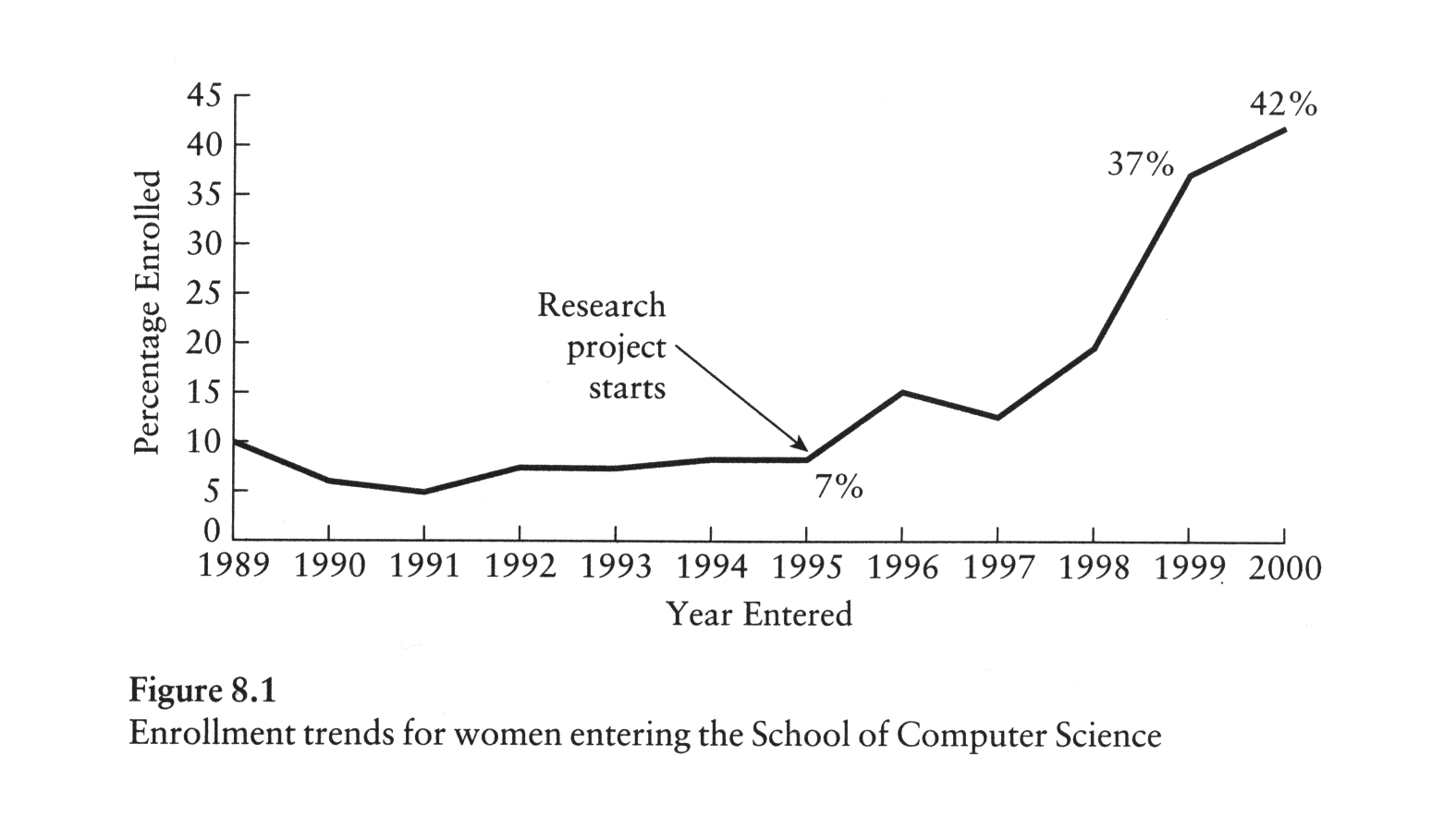
<p>The authors gather scores of previous studies, and they did their own work from a privileged position at the helm of the undergraduate program at Carnegie Mellon University.  Their success at answering these questions may be indicated by the reversal they achieved of national trends at CMU in the five years of their research:</p>
<ul>
<li>Before the authors’ work, the proportion of women among entering freshmen ranged from 5% to 7% over the five years 1991-1995.  At the conclusion of their project in 2000, this proportion had reached 42%.</li>
<p><a href="http://price.mit.edu/blog/wp-content/uploads/2010/02/entrance-graph.png"><img alt="Graph of percentage of women in computer science freshman class at CMU, 1989-2000" class="alignnone size-full wp-image-109" height="377" src="http://price.mit.edu/blog/wp-content/uploads/2010/02/entrance-graph.png" title="Enrollment trends for women entering the CMU School of Computer Science as undergrads" width="662"/></a></p>
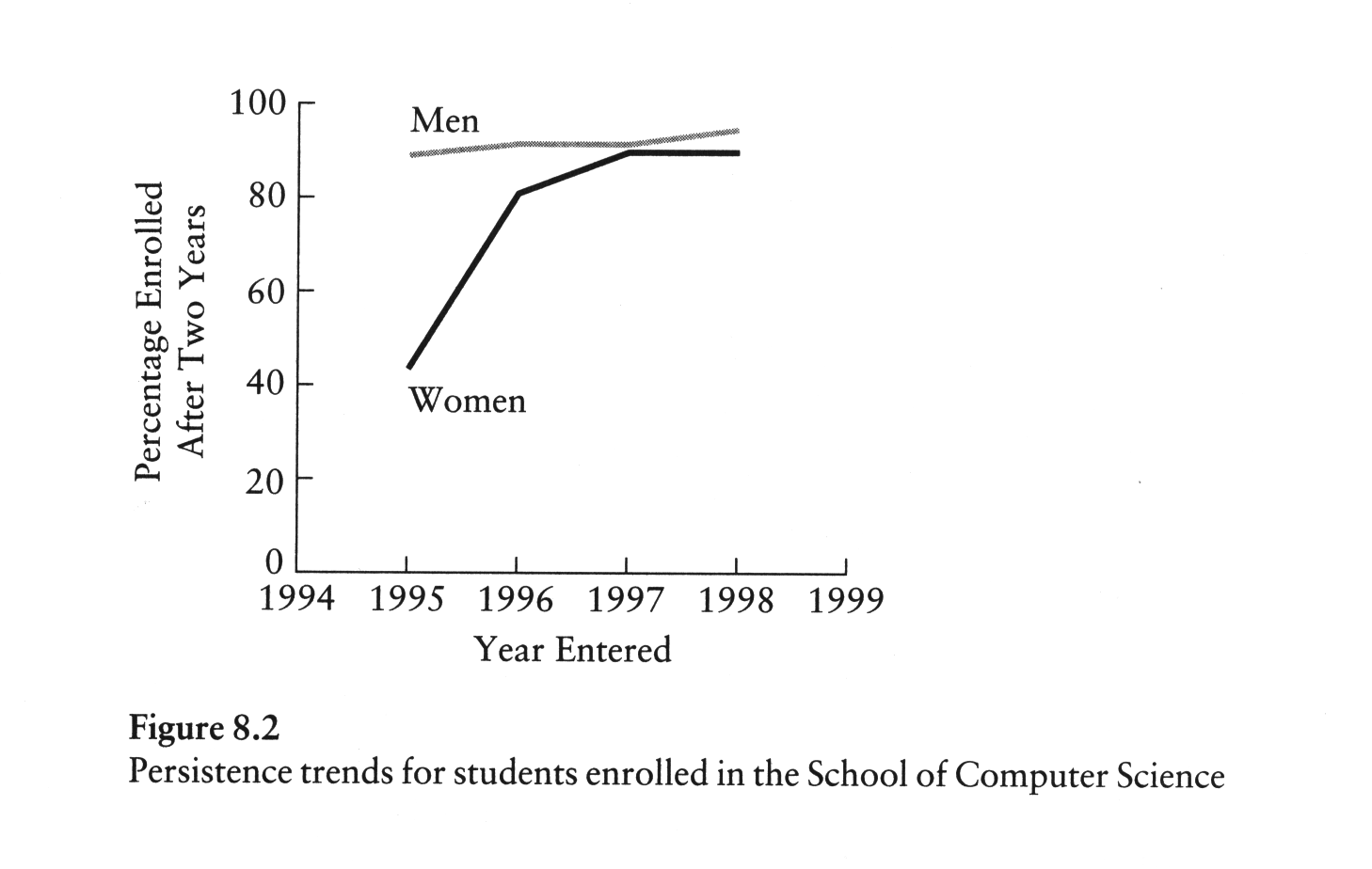
<li>Of students entering the program at the start of the project in 1995, only 42% of women remained after two years.  This rate rose to 80% for women entering in 1996, and stabilized at nearly 90%.  The rate among men was steady around 90%.</li>
<p><a href="http://price.mit.edu/blog/wp-content/uploads/2010/02/persistence-graph.png"><img alt="Graph of persistence rate for women and men in undergraduate computer science at CMU, 1995-1998" class="alignnone size-full wp-image-108" height="388" src="http://price.mit.edu/blog/wp-content/uploads/2010/02/persistence-graph.png" title="Persistence rate for women and men in undergraduate computer science at CMU" width="613"/></a>
</p></ul>
<p>With that kind of success in practice, it’s clear their scientific findings and their recommendations have earned serious consideration.  In a future post I’ll say more about those, and I’ll also look at what some other people have found on the subject.  Ironically, it turns out one result of Margolis and Fisher’s success may have been to invalidate some of their findings in the new environment they created.</p></div></content><updated planet:format="February 15, 2010 06:59 AM">2010-02-15T06:59:20Z</updated><category term="Uncategorized"/><category term="academia"/><category term="computer science"/><category term="sipb"/><category term="women in computing"/><author><name>Greg Price</name></author><source><id>http://price.mit.edu/blog</id><link href="http://price.mit.edu/blog/tag/sipb/feed/" rel="self" type="application/rss+xml"/><link href="http://price.mit.edu/blog" rel="alternate" type="text/html"/><title>price.mit.edu/blog » sipb</title><updated planet:format="January 25, 2026 03:07 AM">2026-01-25T03:07:27Z</updated><planet:format>rss20</planet:format><planet:http_etag>&quot;452a10c017d6ace36ea6c313eb650a31&quot;</planet:http_etag><planet:http_last_modified>Mon, 16 Aug 2010 16:26:14 GMT</planet:http_last_modified><planet:bozo>false</planet:bozo><planet:encoding>utf-8</planet:encoding><planet:css-id>gregory-price</planet:css-id><planet:items_per_page>60</planet:items_per_page><planet:name>Gregory Price</planet:name><planet:days_per_page>0</planet:days_per_page><planet:http_status>200</planet:http_status></source></entry>