8.613/22.611 Intro to Plasma Physics I
Fall 2018
Instructor: Ian H Hutchinson
TA: Samuel Frank
Lecture: TR11-12.30 (NW16-213)
Information:
Announcements
Final Exam Details
You will be allowed a single mnemonic sheet (one-side letter
size) for the final. It will otherwise be closed book, no
electronic aids allowed.
Bring a pen/pencil ;)
Announced on 06 December 2018 1:11 p.m. by Ian H Hutchinson
Bellan's Book
I was asked my opinion of Bellan's plasma physics book in
class. I had the opportunity to read it critically before it was
published. Here are some of the comments I made. They sound very
similar to the brief opinions we shared.
Overall I find the balance of the book rather too mathematical
for my
preference in an introductory text. For example, it derives the
two-fluid equations purely on the basis of a moments expansion of the
Boltzmann equation. This is certainly a correct and in some ways
formally quite rigorous approach, but it is in my view not the best
way to teach beginners in plasma physics what the fluid equations are
all about. Moreover, I notice that even having spent the time on this
mathematical derivation, Bellan does practically nothing in the way of
applications of the two-fluid theory, he just moves on to derive MHD.
Thus the student has no opportunity to build their intuition about how
plasmas can be understood as two interpenetrating electrically charged
fluids. That intuition is something that a top-class text book should
help to grow.
Another example of the imbalance of this formal approach is in
MHD. Bellan includes a lot of formal mathematics that, while excellent,
I would not dream of putting into a one semester introductory
course. I could cite, for example the derivation of the energy
principle, or of the Grad-Shafranov equation. By contrast, so far as I
can see, Bellan nowhere proves or explains the ``freezing in'' of
field lines, which is a crucial intuitive concept that every plasma
student should be exposed to. Nor can I see any MHD explanation of
Alfven waves, another elementary application of MHD that helps
students to see what use it all really is.
This mathematical approach that Bellan pursues is not applied
consistently to all topics. Perhaps it could not be, because the whole
book would become either too long or nothing but formal
derivations. Nevertheless some whole areas are dispensed with in a
completely heuristic way. I have in mind most obviously the question
of collisions. They are discussed in a hand-waving manner in chapter 1
but never treated properly at all. Therefore DC resistivity, and most
transport questions are passed over in a few short paragraphs as if
they are practically irrelevant to plasmas. Probably that was not the
intention, but again, it is a strange choice of balance.
preference in an introductory text. For example, it derives the
two-fluid equations purely on the basis of a moments expansion of the
Boltzmann equation. This is certainly a correct and in some ways
formally quite rigorous approach, but it is in my view not the best
way to teach beginners in plasma physics what the fluid equations are
all about. Moreover, I notice that even having spent the time on this
mathematical derivation, Bellan does practically nothing in the way of
applications of the two-fluid theory, he just moves on to derive MHD.
Thus the student has no opportunity to build their intuition about how
plasmas can be understood as two interpenetrating electrically charged
fluids. That intuition is something that a top-class text book should
help to grow.
Another example of the imbalance of this formal approach is in
MHD. Bellan includes a lot of formal mathematics that, while excellent,
I would not dream of putting into a one semester introductory
course. I could cite, for example the derivation of the energy
principle, or of the Grad-Shafranov equation. By contrast, so far as I
can see, Bellan nowhere proves or explains the ``freezing in'' of
field lines, which is a crucial intuitive concept that every plasma
student should be exposed to. Nor can I see any MHD explanation of
Alfven waves, another elementary application of MHD that helps
students to see what use it all really is.
This mathematical approach that Bellan pursues is not applied
consistently to all topics. Perhaps it could not be, because the whole
book would become either too long or nothing but formal
derivations. Nevertheless some whole areas are dispensed with in a
completely heuristic way. I have in mind most obviously the question
of collisions. They are discussed in a hand-waving manner in chapter 1
but never treated properly at all. Therefore DC resistivity, and most
transport questions are passed over in a few short paragraphs as if
they are practically irrelevant to plasmas. Probably that was not the
intention, but again, it is a strange choice of balance.
Announced on 06 December 2018 12:48 p.m. by Ian H Hutchinson
Student Subject Evaluation for Introduction to Plasma Physics
The Fall 2018 end-of-term subject evaluations
(http://registrar.mit.edu/subjectevaluation) are open. Students
have until Monday, December 17 at 9 am to complete their
surveys.
Please give thoughtful and candid evaluations of the strengths
and weaknesses of the class. This supports the continuous
improvement of the course and (at least when constructive)
encourages the instructor! Thanks.
Announced on 06 December 2018 10:51 a.m. by Ian H Hutchinson
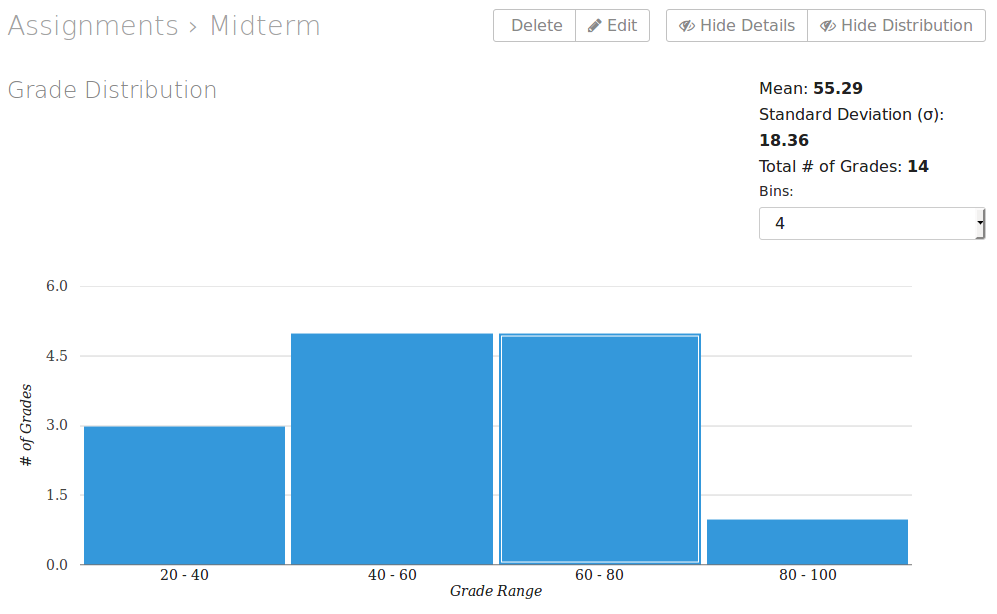
Midterm Score Distribution
Since the gradebook seems to be broken (no surprise there!)
you can view the distribution at
Announced on 31 October 2018 4:10 p.m. by Ian H Hutchinson
Proposed "Recitations"
In discussion with some of you who had a disappointing midterm
result, I have proposed that I hold a kind of recitation, which is
aimed at helping to absorb and master the material of the course
(not at all to introduce new material). The sorts of activities
this will involve will be discussions of questions or puzzles about
the lectures, or (mostly past) problem sets, or additional problems
drawn from textbooks. Students who attend will take a large share
of the responsibility for keeping the conversation going. (So we
might end early if we run out of things to say.)
Although Friday at 11 is clear for most students, Friday is
usually not possible at that time for me.
Wednesdays at 11am are not possible for key students, but I
think later in the day would work.
Therefore the time I propose is 2pm Wednesdays as follows: Nov
14, 21, 28, Dec 5th. (Many are away next week.)
If there is a common unforseen difficulty with that proposed
time, please raise it tomorrow in class.
Announced on 31 October 2018 4:05 p.m. by Ian H Hutchinson