The case for electrical efficiency
For better fuel economy, many devices now driven directly by the engine will be driven electrically. That way, the speed of, say, the water pump and the cooling fan can be varied to match the load or even turned off when not needed. To get the most out of switching to electric drive, the requisite electric motors should be operated at voltages substantially above 12 V to boost their efficiency.
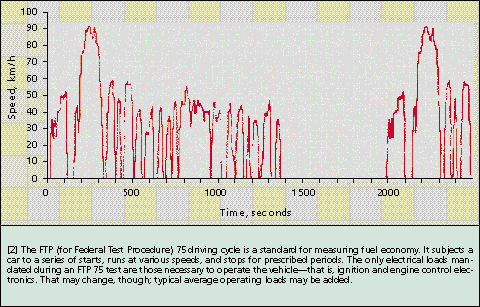
Fuel economy also dictates that electricity be distributed at higher voltages, to reduce ohmic losses without resorting to a heavy and expensive harness of large-gauge wire. Improving the electrical system's efficiency so it lops 100 W off the average electrical load has the same effect on fuel economy as reducing the car's weight by 50 kg, as measured by the FTP (Federal Test Procedure) 75 standard profile of starts, runs, and stops [Fig. 2].
Even more to the point, the U.S. Corporate Average Fleet Efficiency (CAFE) standard prescribes a maximum fuel consumption rate for cars sold in the United States. The Federal government assesses a penalty of US $5 for every 0.1 mile per gallon (0.04 kilometer per liter) below 27.5 mi/gal (8.55 L/100 km) on every car the manufacturer sells. A 200-W electrical load accounts for about 0.4 km/L in the FTP 75 cycle test; so, if a manufacturer is delivering 25-mi/gal (9.41 L/100 km) cars, for example, it can justify spending more per vehicle on components to improve electrical efficiency.
At present, when U.S. and European fuel economy tests are conducted, only those electric loads essential to the operation of the vehicle are active--that is, the ignition and engine electronics. Lights, air-circulating blowers for the passenger compartment, entertainment electronics, power windows, and so forth are all turned off for the tests. But this could soon change. If a typical average electrical load is required during tests, the electrical performance of the car will become much more visible.
Nowhere will this visibility be greater than in the 80-mi/gal "green" car. A midsized car resembling a Ford Taurus or Chevrolet Lumina, it is the goal of the U.S. Partnership for a New Generation of Vehicles (PNGV), which comprises 11 Government agencies and the Big Three's U.S. Council for Automotive Research. (European manufacturers are pursuing the same goal, a car that consumes 3 L/100 km.) But unless the electrical system in today's car models is improved, over 25 percent of the green car's fuel will go to electrical loads. And if some mechanical functions such as air conditioning and power steering are electrified, that fraction could rise to 50 percent. If the partnership's green car is not to be a bare-bones model, then it will have to incorporate a truly superior electrical system.
Another strong motivator for electrical efficiency is the high cost of automotive electricity--a lot more than homeowners pay for theirs. The cost can be calculated in a straightforward way. Gasoline has a heat energy content of 43.5 megajoules per kilogram and a density of 0.73 kg/L, which gives it a volumetric energy content of about 32 MJ/L, or 8.8 kWh/L. Thus if the engine efficiency is 40 percent and the alternator/belt efficiency is 45 percent, a liter of gasoline furnishes approximately 1.6 kWh to a car's electrical system. Assuming a gasoline price of US 34 cents per liter, the cost of generating electricity in a car works out to about 21 cents per kilowatt-hour, substantially more than the 8 cents per kilowatt-hour average price of residential electricity in the United States.