Automotive electrical systems circa 2005
go to previous page
Laying the groundwork
The MIT working group came up with a list of features it anticipated would be offered as options in luxury car models for the year 2005, and calculated their electric power demands for both summer and winter [see table]. Some of these loads, such as the water pump, replace existing mechanical loads; some, like the electrically heated catalytic converter, are a response to regulatory mandates; and some are suggested by safety or driver convenience, the heated windshield, for example. Most of the new loads would benefit from a voltage higher than 12 V dc, and several, such as the electromechanical valves and active suspension, would require much higher voltages.
Incidentally, the group took an electrically driven air-conditioning compressor into consideration as a future electrical load. Its chief advantage would be packaging flexibility, since a drive belt would no longer be needed and the compressor could be placed anywhere in the vehicle. Also, with electric drive, the compressor speed could be varied to match the cooling load efficiently. But the load would be very large, and since it is now supplied effectively by a mechanical drive, the merits of conversion to an all-electric compressor drive in high-end cars are controversial.
There is little doubt, though, that the green car envisioned by the Partnership for a New Generation of Vehicles will be electrically air conditioned. That midsized car will have to be designed to cut the cooling load to 1.5 kW, however--about half of what today's equivalent cars consume.
 The loads that are included on the list seem amply justified. A case in point is the active suspension system, whose introduction may very likely parallel that of air conditioners in automobiles. Thirty years ago, few cars had air conditioning; today it is difficult to buy a car in the United States without it. When first introduced, air conditioning was a very expensive option--up to 10 percent of the purchase price of the car. It also put a big dent in fuel economy at a time when the price of gasoline was higher in real dollars than it is today. But the comfort it afforded was so valued by consumers that within a decade, air conditioning became de facto standard equipment.
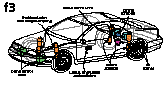
The MIT group foresees a similar future for active suspension systems, which keep the passenger compartment on a flat trajectory as the car wheels swerve and bounce over potholes, ruts, and rough roads. The systems sense a vehicle's vertical accelerations and energize electromechanical actuators to counter them [Fig. 3]. Expensive, heavy, and power-intensive (although not energy-intensive), an active suspension system will need voltages of about 350 V to operate efficiently. But it can improve a rider's comfort to the same extent that air conditioning did, and car buyers will probably embrace it just as enthusiastically.
go to next page