|
Zero-Gravity Aerogel
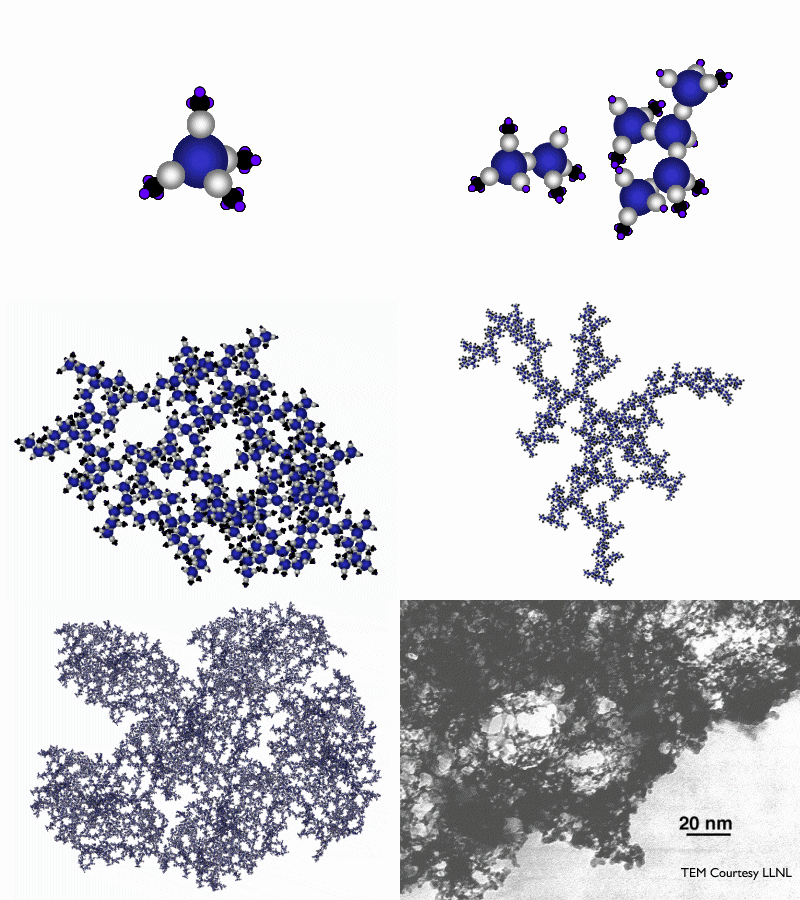
Formation The MIT Zero-G Team is currently working on an experiment investigating the effects of gravity on the formation of a class of materials called aerogels. Background: What are Aerogels? Aerogels are remarkable nanostructured materials with an array of valuable properties including the lowest densities of all solid materials, high internal surface areas, and excellent insulating capabilities. Silica aerogels are exciting because they can be made almost perfectly optically transparent, but have the insulating ability twice that of extruded polystyrene (i.e., StyrofoamTM). Aerogels start their life out as a gel (like Jell-OTM). A gel is a colloidal system in which a nanoporous network of particles spans the volume of a liquid medium--effectively a open-celled sponge-like solid with liquid filling its pores. Gels are typically somewhere between 90-99.5% liquid in volume. Aerogels are the solid component of gel isolated from its liquid component and are made by extracting the liquid from a gel under conditions which do not cause the gel to collapse, for example, by supercritically extracting the liquid from the pores and replacing it with gas.
A gel in turn starts its life out as a liquid in which small molecules link up (polymerize) to form larger molecular clusters, which eventually grow large enough that they collide and create a continuous network spanning the container which holds the liquid. During this process, the components of interest transition from a domain where their behavior is governed almost exclusively by Brownian motion to a domain where they are also influenced by Newtonian forces such as buoyancy and convection.
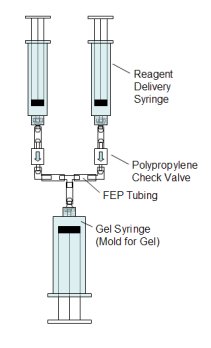
As a result of this phenomenon, the properties of a gel's morphology are affected by the presence of an acceleration field (i.e., gravity) which is responsible for secondary effects such as buoyancy and convection. Experimental Goals The goal of the experiment is to characterize how the presence of gravity affects the properties of an aerogel's structure, specifically its surface area, skeletal density, and optical properties. Experiment Methodology Silica-based gels will be formed in reduced gravity environments (microgravity, lunar gravity, martian gravity), 1 G, and 1.8 G aboard ZERO-G Corp.'s G-FORCE ONE B727 aircraft. The gels will be formed using a special rapid gelation technique which will allow for gel formation in approximately 17 seconds. The temperature of the gel solutions will be monitored as they gel. The temperature and barometric pressure of the surroundings and three axes of acceleration will be monitored as well. After the flight, the gels will be supercritically dried and analyzed using BET nitrogen adsorption surface area analysis, helium pycnometry, mechanical compression, and spectrophotometry. Equipment The experiment will use special contained-volume molds (CVMs) to enable mixing of liquids and gel formation in variable gravity environments. Two syringes will be pre-filled with liquids which, upon mixing, will result in a gel. When the syringes are depressed, the liquids will flow through check valves, mix, and enter into a larger third syringe where the gel will set.
The CVMs will be housed inside a special double-layered aluminum/polycarbonate glove box which has flown six times in zero-gravity. The box was inherited from the University of Wisconsin (hence the bumper sticker).
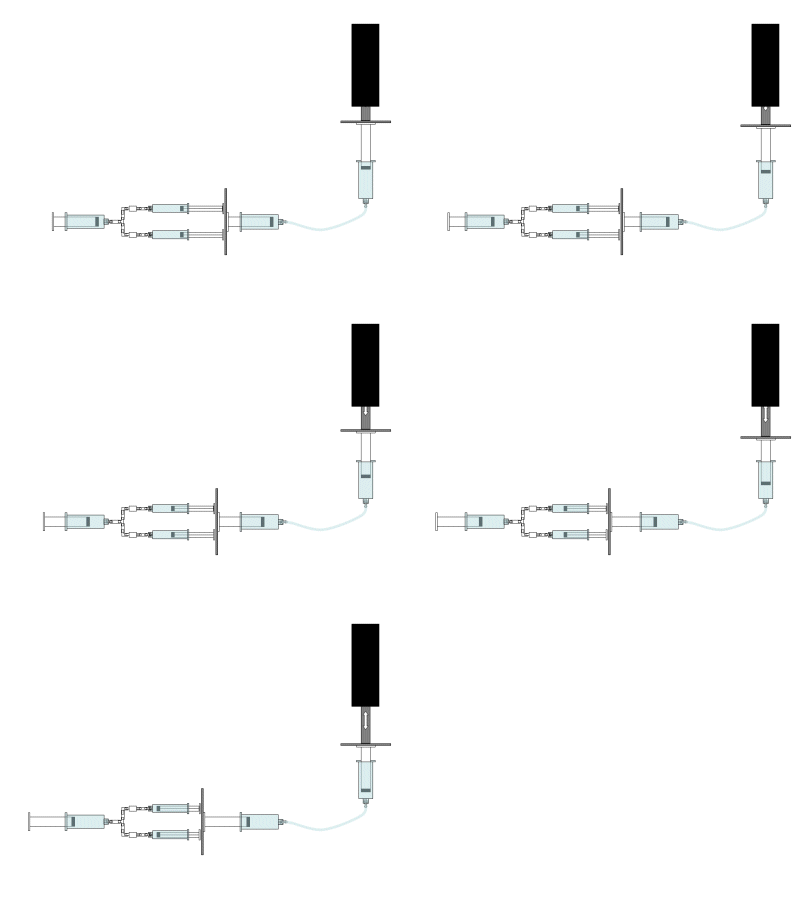
The molds are actuated with a computer-controlled electromechanical actuator which depresses a particular line in a hydraulic system which in turn depresses the syringes on a CVM.
Using a hydraulic system, we can automatically actuate the molds, which greatly simplifies experimentation and ensures reproducibility, as well as utilize the maximum volume possible in the experiment box, which enables multiple trials per parabola and thus greater reliability in experimental analysis and data collection.
About the Parabolic Flight Our accelerometer data shows that the average zero-gravity parabola aboard ZERO-G's B727 is between 13 and 21 seconds long, with the average being around 18 seconds.
|
|